
Kids-Safe Scent and a China OEM: Six Assumptions That Cause Rework
Rework on a kids-safe fragrance project rarely starts at the factory. It starts with an assumption the brand carried into the brief - that kids-safe is a single specification, that a lower fragrance load is automatically gentler, or that the supplier's local rules match the market the product is sold in. Each of those assumptions is reasonable and each one costs a sample round. The fix is to write the assumptions down and check them before sampling begins.
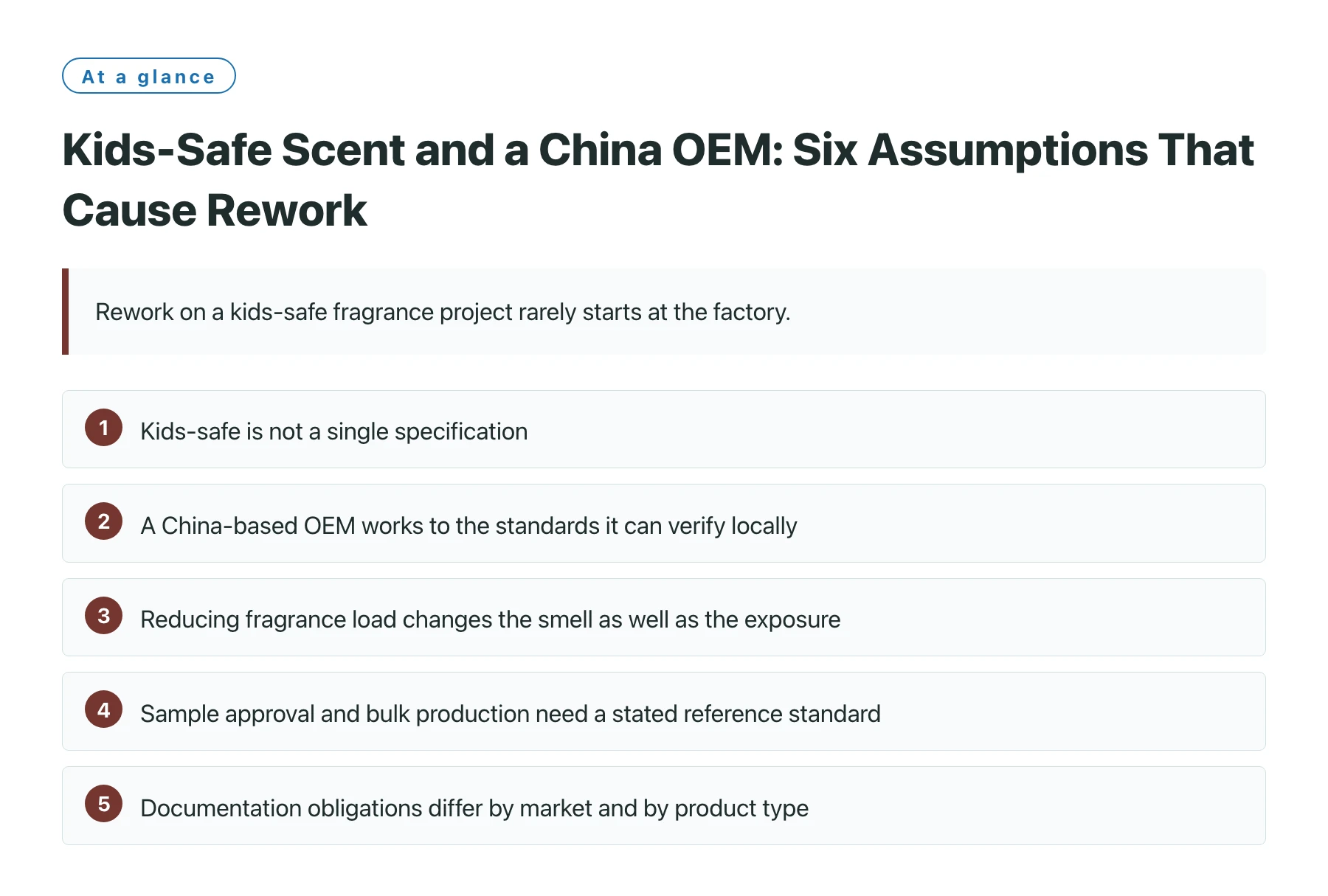
Key takeawaysKids-safe is not a single specification; it is a set of decisions about fragrance load, materials, packaging and labelling that has to be written into the brief item by item. · A China-based OEM works to the standards it can verify locally, so the brand has to state the destination market's requirements explicitly rather than assume they are covered. · Reducing fragrance load changes the smell as well as the exposure, so it is a formulation decision that has to be made with the perfumer rather than a number imposed on the brief. · Sample approval and bulk production need a stated reference standard, otherwise the kids-safe version and the approved sample drift apart without anyone noticing. · Documentation obligations differ by market and by product type, so they belong in the first brief rather than in a conversation three weeks before shipping.
A children's or family-oriented scent product looks like an easy brief until it reaches a factory. The category is defined by restrictions rather than features, and the brand usually arrives with a strong sense of what it wants to avoid and a much weaker sense of what has to be documented.
Working with an OEM in China adds distance to that problem. The supplier is competent and experienced, but it can only act on requirements that have been stated. Anything the brand assumes is understood but never writes down becomes a gap that appears at the sample review or, worse, at the compliance check before shipping.
The six assumptions below are the ones that show up most often in kids-safe briefs. Each is plausible, and each has a cheap fix if it is caught before the first sample round.
Why cross-border kids-safe briefs go wrong before sampling starts
Fragrance briefs fail for two reasons: missing decisions and mismatched vocabulary. On a kids-safe project both are amplified. Missing decisions are the ones the brand assumes the supplier will make sensibly - load, materials, closure, labelling. Mismatched vocabulary is worse: words like gentle, natural and safe mean something specific to a formulator and something vaguer to a marketing team.
The result is a quotation built on the brand's adjectives rather than on a specification. When the first sample arrives and it is not what the brand pictured, the supplier has followed the brief it was given, and the cost of the correction lands on the brand.
Writing the brief in decisions rather than adjectives is the whole discipline. It is also what makes quotes comparable: two suppliers quoting against the same list of decisions produce numbers that can be lined up, while two suppliers quoting against a paragraph of intent produce numbers that cannot.
Distance makes assumptions more expensive
A local supplier can walk a brand through the constraint in a corridor conversation. A supplier on another continent cannot, so the brief has to carry the context. Every requirement that is left implicit - the market, the age positioning, the channel, the claims on pack - is a decision the factory will make by default.
The brief is also a comparison tool
When several factories are being considered, the value of a written brief is that it freezes the question. A perfume production partner in China will quote against it, and the differences that then appear are differences between suppliers rather than differences between conversations perfume production partner in China.
Six assumptions, and what to write instead
| The assumption | What usually happens | What to write instead |
|---|---|---|
| Kids-safe is one specification the supplier knows | Each supplier interprets it differently, so quotes describe different products | A written list of decisions: fragrance load range, materials to avoid, packaging restrictions and label claims |
| Lower fragrance load is automatically gentler | The scent reads thin and flat, and the brand rejects a formula that met the brief | A target load range agreed with the perfumer, plus a defined wear or diffusion target |
| The factory's local rules cover my market | Documentation arrives that satisfies one jurisdiction and not the destination | The named destination market and its labelling and safety documentation requirements in the brief |
| A sample is the specification | Bulk production drifts from the approved reference with nothing to measure against | A retained reference sample plus written tolerances for colour, odour and fill |
| One formula can serve shampoo and body lotion | The same juice behaves differently in a rinse-off and a leave-on base, and one version underperforms | Either two adapted versions or an explicit decision that the fragrance stays a top-note accent |
| Compliance work happens after the formula is locked | A restricted material forces a reformulation at the worst moment | A restricted-material check on the formula before approval, with headroom documented |
Notice how many of these are brand-side decisions rather than factory capabilities. That is the point: the factory can execute an unusual brief far more reliably than it can guess an unstated one.
The definitions that have to be agreed in writing
Three definitions cause most of the avoidable argument on a kids-safe project: which materials are restricted, what the destination market requires, and who verifies the result.
On materials, the industry maintains use standards that restrict how much of a given fragrance material may be used, and in which product categories [1]. Those restrictions apply to the finished formula rather than to a single ingredient, so the check has to be run on the version that will actually be produced. A brand that asks for the restricted-material picture before approving the sample learns two useful things: whether the formula has headroom, and whether the perfumer expects to reformulate later.
Naming and identification
Ingredient naming across markets is not always identical, and a label review can stall on a name that does not match the reference database used by the destination market's authority. The European Commission maintains a cosmetic ingredient database that is commonly used for this purpose, and asking the supplier to check its declaration list against that reference prevents a labelling correction later [2].
Verification and market rules
Decide early who tests what. An independent laboratory report is often the only evidence a retail buyer will accept for a claim about a finished product, and asking a supplier to arrange it is straightforward if it is agreed at the brief stage [3]. It is far harder to bolt on after production, when the batch has already been filled and packed.
Destination market rules also differ more than brands expect, and cosmetic safety requirements are administered nationally even where the underlying principles overlap [4]. Naming the market in the brief is not a formality; it is what allows the supplier to say what it can and cannot document.
Keep the approved reference sample, and keep it properly. A kids-safe project that runs for months across two or three sample rounds has a real chance of drift, and drift is invisible without a physical reference held at a controlled temperature. Agree at the brief stage who retains the reference, how it is stored, and what the brand will compare against it at delivery. This one habit prevents the most common dispute in fragrance manufacturing: a bulk order that smells slightly different from the sample and no shared standard to judge it by.
Choosing the partner for this kind of brief
The right supplier for a kids-safe project is not necessarily the one with the longest list of categories. It is the one that asks precise questions, returns a written brief with its own assumptions marked, and can describe how it handles a restriction that bites after sampling.
Ask whether the manufacturer works in both OEM and ODM modes. A brief where the brand supplies the concept needs OEM discipline; a brief where the brand wants candidates from an existing library needs ODM range. A manufacturer that supports OEM and ODM can move between the two without the brand changing supplier mid-project a manufacturer that supports OEM and ODM.
Finally, check the manufacturing background rather than the presentation. A factory that has produced fragrance and personal care for decades will have policies for restricted materials, retained references and batch records that predate your project, and asking to see those policies is a fair request its background and certifications. For a product positioned around children, that institutional habit matters more than any single claim on a website.
Sources
- IFRA Standards Library (International Fragrance Association) —— The IFRA Standards Library lists the restrictions the fragrance industry applies to individual fragrance ingredients, based on safety assessments; it is the reference point for compliant fragrance formulation.
- EU CosIng — Cosmetic Ingredient Database (European Commission) —— The European Commission's CosIng database of cosmetic ingredients, listing ingredient functions, restrictions and labelling requirements under EU cosmetics law.
- SGS: Cosmetics, Personal Care & Household Testing —— Testing, inspection and certification services for cosmetics and personal care, including microbiological, stability and safety testing aligned with cosmetics GMP.
- Health Canada: Cosmetic Safety —— Health Canada's cosmetics pages, covering cosmetic notification, the ingredient hotlist and safety requirements for cosmetics sold in Canada.
Frequently asked questions
What does kids-safe actually require in a fragrance brief?
It requires decisions rather than a certification. In practice a brand should specify the target fragrance load range, materials or material families it wants avoided, the packaging restrictions that follow from the age positioning, the destination market, and the label claims it intends to make. Those five items turn the phrase into something a factory can quote.
Is a lower fragrance load always the safer choice?
Not automatically. Load interacts with the base and with the materials chosen, and reducing it can leave a scent that reads thin and needs more work to feel finished. The useful approach is to agree a load range with the perfumer against a performance target rather than treating a low number as a goal in itself.
Do I need a separate formula for a shampoo and a body lotion?
Often yes, because the same fragrance behaves differently in a rinse-off base and a leave-on base. Some brands accept one formula used as a lighter accent in both. Either answer is workable, but it has to be an explicit decision in the brief rather than a discovery after sampling.
Who should arrange compliance testing for a kids-safe product?
Decide it at the brief stage. Some suppliers include standard testing in their scope and some arrange it through a third party at cost; retail buyers usually want an independent report. What matters is that the responsible party is named in writing before production, not agreed after the batch is filled.
How do I stop bulk production drifting from the approved sample?
Retain a physical reference sample under controlled storage, write tolerances for odour, colour and fill, and compare the delivered batch against the reference. Without a retained reference there is no shared standard, and the conversation becomes a matter of memory on both sides.
Planning a custom home, addition, or major renovation?
Get a free 12-phase roadmap tailored to your project — no obligation.