
What chatbot has no limits?
A chatbot with no limits does not fully exist, but some AI systems offer fewer restrictions through open-source models, local deployment, and customizable platforms. In 2025, commercial AI chatbots reached hundreds of millions of users worldwide, while open models allowed developers to modify behavior, add tools, and control data. The closest options to a “no limits” chatbot are systems that provide greater flexibility rather than removing every rule.
AI chatbots have different types of limits, including message caps, context length, content policies, model access, and customization options. A user searching for an unrestricted chatbot may want longer conversations, fewer creative restrictions, private processing, or the ability to adjust the AI’s behavior. In 2025, major AI platforms were serving millions of requests daily, but each system applied different controls based on safety requirements, computing resources, and product design.
“No limits” usually means more user control, not an AI system with zero restrictions.
Commercial chatbots remain the most accessible option because they combine advanced models with stable infrastructure. Platforms such as ChatGPT, Claude, and Gemini provide coding assistance, document analysis, writing support, and research capabilities. However, these services operate under company policies. Many paid plans increase usage limits, provide larger context windows, and unlock additional tools, but they still maintain platform-level restrictions.
The difference between commercial and open AI systems becomes clearer when looking at customization. Open-source models allow users to download model files, modify responses, and run AI on personal hardware. In 2023, Meta released the Llama model family, and by 2025, thousands of developers had built applications around open-weight models. These systems provide more flexibility because users can control prompts, fine-tuning methods, and software connections.
| Type of chatbot | User control | Common limits |
|---|---|---|
| Commercial AI chatbot | Medium | Platform rules, usage limits |
| Open-source model | High | Hardware requirements, technical setup |
| Local AI assistant | Very high | Computer performance, maintenance |
| Custom AI agent | High | Depends on tools and data quality |
Open-source AI is often considered the closest approach to a chatbot without limits because users decide how the system operates. A model running locally does not require sending conversations to external servers, and users can modify the interface, connect private databases, or create specialized assistants. However, freedom comes with technical requirements. A large model with tens of billions of parameters may need powerful GPUs, large memory capacity, and optimization methods.
The hardware requirement has become lower as smaller models improve. In 2024 and 2025, many efficient models with 7 billion to 14 billion parameters became usable on consumer computers with enough memory. Quantization techniques reduced model size by more than 50% in many cases while maintaining acceptable performance. This development allowed more users to test private AI systems without relying entirely on cloud platforms.
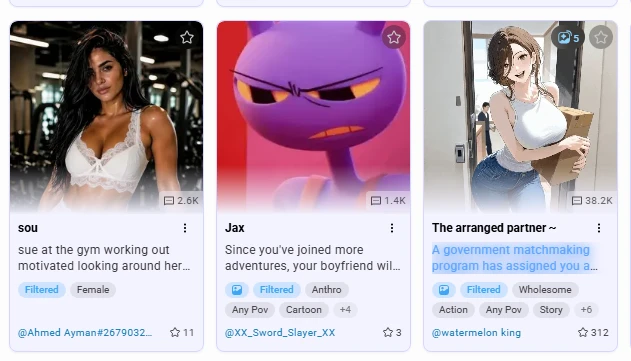
Another approach involves AI platforms designed for customized conversations. These services focus on user-created characters, personalized assistants, and flexible interaction styles. For users who want fewer restrictions in casual conversations, creative writing, or role-based interactions, these platforms may provide a different experience from general-purpose assistants.
One example frequently discussed among users looking for more flexible chatbot experiences is https://crushon.ai/. It focuses on customizable AI conversations and allows users to interact with different AI personalities. Compared with general productivity assistants, platforms like this are designed around personalization and conversation style rather than office tasks or research workflows.
The demand for flexible AI chatbots is also connected to privacy concerns. Many users prefer systems where their conversations remain under their control. Local AI deployment provides this option because models can run directly on personal devices. According to industry reports from 2024, private AI adoption increased as companies and individuals looked for ways to process sensitive information without sending all data to third-party platforms.
“More freedom often requires more responsibility from the user.”
A chatbot with fewer restrictions may produce more varied responses, but users still need to evaluate accuracy. Large language models generate text by predicting patterns from training data, which means they can sometimes create incorrect information. Studies published between 2023 and 2025 showed that even advanced AI models could produce factual errors in areas such as law, medicine, and technical documentation.
For professional users, the best chatbot is usually not the one with the fewest restrictions but the one that matches the task. A software developer may prefer a model that can analyze large codebases. A researcher may need long context windows and document processing. A writer may prefer creative flexibility. Different users define “no limits” differently.
AI model performance has also improved rapidly. In 2025, leading language models supported context windows reaching hundreds of thousands of tokens, allowing users to analyze long reports, books, and datasets. At the same time, smaller models became more efficient, creating more choices between cloud-based systems and private installations.
The future of unrestricted AI will likely involve a combination of cloud services, local models, and personal AI agents. Instead of one universal chatbot without limits, users may rely on different AI systems for different tasks. A personal assistant could run locally for private information, while a cloud model could handle complex reasoning that requires more computing power.
No chatbot today removes every limitation. Commercial systems provide convenience and reliability, while open-source and local models provide greater control. The closest experience to a chatbot with no limits comes from platforms that allow users to customize behavior, manage data, and choose how the AI system operates. Greater flexibility, rather than unlimited access, is becoming the main direction of AI chatbot development.
Planning a custom home, addition, or major renovation?
Get a free 12-phase roadmap tailored to your project — no obligation.